Cricket is a bat-and-ball game played between two teams of eleven players on a field at the centre of which is a 20-metre (22-yard) pitch with a wicket at each end, each comprising two bails balanced on three stumps. Explaining cricket to a complete beginner is a little complicated, as the game is defined by several complex rules. Playing cricket is the easiest way one can really understand the game, all the while having fun at the same time. However, here we have tried to explain the game mechanics in as simple as a way possible:
The game of cricket is a game of runs, wickets/dismissals and overs. The batting side scores runs by striking the ball bowled at the wicket with the bat, while the bowling and fielding side tries to prevent this and dismiss each player (so they are “out”). Means of dismissal include being bowled, when the ball hits the stumps and dislodges the bails, and by the fielding side catching the ball after it is hit by the bat, but before it hits the ground. When ten players have been dismissed, or in some cases, the limited number of overs are completed, the innings ends and the teams swap roles. The game is then won either by the second batting team surpassing the runs scored by the first team, or when the ten players of the team batting second are dismissed by the first team.
The game is officiated by two ‘umpires’ (on field referees), aided by a third umpire (video referee) and match referee in international matches. They communicate with two off-field scorers who record the match’s statistical information.
A single run is said to be scored by the batsman when he/she hits the ball and both the batsmen on field complete running across the markings (crease) at each ends of the pitch. Each run scored by the batsman adds up to the total runs scored by the batting team. When the batsmen run twice across, two runs are awarded to the batsman hitting the ball, and when they run three times across, three runs are awarded and so on. If the batsman hits a ball directly over the boundaries of the cricket field, six runs are awarded and when the ball hits the ground within the field boundaries and then crosses over, four runs are awarded to the batsman.
When a bowler legally bowls the ball six times, an ‘over’ is set to be completed. The bowling side bowls through out the innings until the number of overs defined have been bowled, or 10 out of 11 batsmen in the batting team are dismissed. There are several ways a batsman can be dismissed in the game of cricket. The batsman can either
– be ‘bowled’, where the ball hits the wickets behind the batsman during the process; or
– be ‘caught’, where the ball hit by a batsman is caught by a player from the opposite team before it first touches the ground; or
– be ‘run out’, where the batsman fails to complete a run and a player from the opposite team hits the wickets with the ball; or
– be ‘stumped’ by the wicket keeper (a player in the opposite team standing behind the batting wickets), where the batsman comes out of the ‘crease’ to hit the ball, misses, and is caught by the wicket keeper and he hits the wickets before the batsman comes back in to the crease; or
– be declared as ‘leg before the wicket’, where a ball going on to hit the wickets is first blocked/touched by the body of the batsman before/without hitting the bat ; or
– be declared as ‘hit-wicket’ when the batsman hits the wicket with his bat or any body part, during the course of the delivery of the ball; or
-be dismissed unconventionally, where the batsman uses his hands to stop/push away the ball going to hit the wickets while the ball is in play (during a delivery or a run).
Source and more information: Wikipedia (EN, DE)

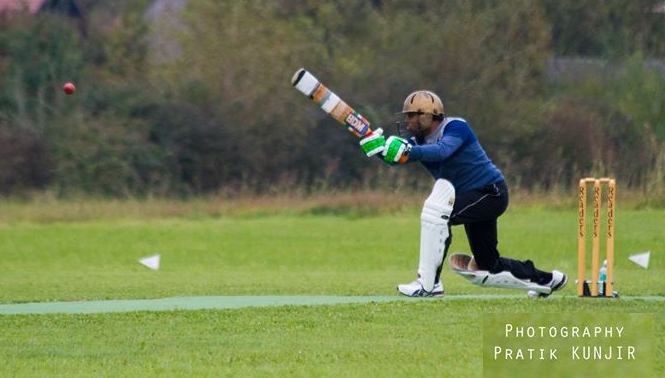
The game of cricket is called the ‘Gentleman’s game’, as even slight misconducts during the game are awarded immediate penalties. Even an arguement with the on-field umpires can bring in misconduct penalties to the player/team. Thus, even children who play cricket are taught ‘the umpire’s decision in a match is the final decision’. At the professional level international cricketing events, players charged with misconduct are sent off the ground, and harsh financial penalties are awarded after the game. The International Cricket Council (ICC) has a hearing where the charged player can defend himself, and is only conducted at a later time. Players of both teams playing the game have to behave according to the code of conduct of the game, and ultimately uphold the spirit of the game.
As of now there are officially three formats of the game in the international level, as defined by the ICC. However, at smaller levels, cricket can be played with many formats, with several rules simplified. Most of the games played in Austria (Austrian Cricket Association, ÖCV-ACA) and Slovenia (Slovenian Cricket Association, SCA) are official matches organised by the respective cricket boards, who are affiliated members of the ICC, thus follow the similar rules. In Austria and Slovenia, limited overs games are officially conducted by the respective boards, and registered teams compete against each other in a ‘league’.
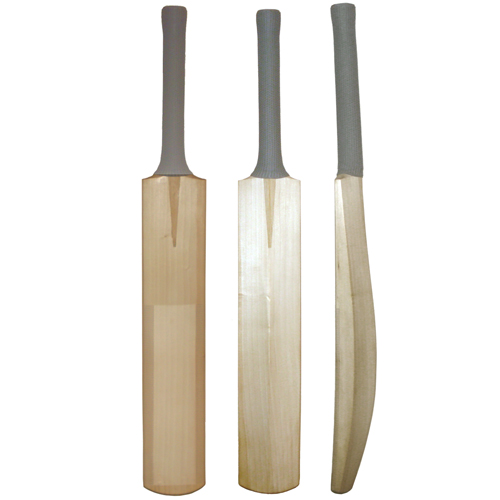
A cricket ‘Bat’
A cricket bat is a specialised piece of equipment used by batsmen in the sport of cricket to hit the ball, typically consisting of a cane handle attached to a flat-fronted willow-wood blade. The length of the bat may be no more than 38 inches (965 mm) and the width no more than 4.25 inches (108 mm). Its use is first mentioned in 1624. Since 1979, a law change stipulated that bats can only be made from wood.
Source and more info: Wikipedia (EN, DE)
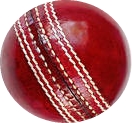
A cricket ‘Ball’
A cricket ball is a hard, solid ball used to play cricket. A cricket ball consists of a cork core wound with string then a leather cover stitched on, and manufacture is regulated by cricket law at first-class level. Cricket balls are harder and heavier than baseballs.
Source and more info: wikipedia (EN, DE)
Cricket Accessories
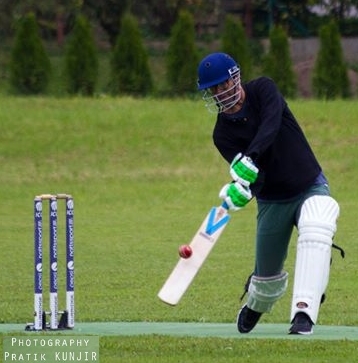
Batsmen in cricket have to face a heavy ball bowled at high speeds, so protection is a must. A helmet specifically designed for playing cricket is worn by the batsman along with protection guards for his groin, thigh, elbow, chest and padded guards and gloves for the feet and the hands. Specific shoes with toe protection must also be used, as injury to the toes are also very common.
More info: Wikipedia (EN,DE)
Official formats in professional Cricket
Unlimited Overs/ Test Cricket
Test cricket is the most pure format of the game, where the game is played without limitations for the number of overs for up to five consecutive days.
Furthermore, both the teams get two innings for batting. The team batting first would make a total, and the team batting second would strive to pass the total and set a ‘lead’. Once sufficient lead has been set, the first team bat again, and are given a chance to surpass the lead set, and then eventually set a target for the second team.
Test Cricket is usually played with the red cricket ball, and is usually played only during daylight hours. A new day/night test format has been introduced, where the teams play with a ‘pink’ ball for better visibility during the nights, under the lights.
Limited Overs/
One-day Cricket
One day cricket is a shorter version of the game, with a limited number of overs (normally fifty overs), and can take up to almost 10 hours for completion.
Here, the team batting first tries to make a sufficient total in the limited number of overs, while the bowling team tries to restrict them. Once the batting team has been dismissed, or the limited number of overs are completed, the team batting second tries to overcome the total of the first team in the same number of limited overs
One-day cricket is played with a white cricket ball, and is played both during daylight hours and also under the stadium lights. For better visibility of the white ball, the teams playing this format usually wear coloured jerseys.
Limited Overs/
T-20 Cricket
T-20 or twenty twenty cricket is the shortest format of cricket, where each innings are limited to 20 overs each. The rules are similar to one-day cricket, but with smaller available overs per innings, the team batting first strives to perform greatly so as to set a large total, while the bowling team tries to completely restrict the first team. This increases the difficulties for both teams, and is more entertaining. With only 20 overs each innings the game is completed within around four hours.
T-20 cricket is also played with a white cricket ball, and is usually mostly played under the stadium lights in the evening/ night, as the goal of this format is to gain more audience.
What people say about the game of Cricket.
“Cricket is quite a gentle, harmless game, but he is a lucky man who has not to sweat some blood before he’s done with it.”
– John Snaith
English Cricketer, Author (Willow the King, 1899)
” If you want fame for yourself, go play an individual game. “
– Gautam Gambhir,
Ex-member, Indian Cricket Team
“Cricket as a passion is distinctly contagious”
– David Frith
Author, historian, and founding editor of Wisden Cricket Monthly

